


5 Questions to Ask Before You Build the AI Project Your CEO Just Pitched
You know the email. It shows up Tuesday morning, forwarded with a few lines of enthusiasm and a ChatGPT-drafted proposal attached. "Saw this and thought of us. Can we do this?" The PDF has a logo, bullet points, and exactly zero integration requirements. It also has a six-week timeline and a budget that assumes nothing goes wrong.
You have somewhere between 24 and 72 hours before your CEO follows up asking what you think.
If you say yes, you're on the hook for a project you didn't scope. If you say no, you're the person who kills ideas. Neither answer is actually available to you. What you need is a third path: a structured evaluation that produces a defensible, professional response in the time it takes to drink your morning coffee.
That's what the Technical Reality Check is. Five questions. One page. Every answer points directly at a commitment your organization will have to honor if this project moves forward.
Here it is in full.
The Technical Reality Check: 5 Questions That Surface What the Proposal Left Out
Question 1: What specific business outcome does this solve, and how will we measure success?
AI tools generate confident-sounding proposals that describe solutions, not problems. A proposal for "an AI-powered IT ticketing system" describes a technology. It doesn't describe what's broken right now, how broken it is, or what "fixed" looks like in measurable terms.
Before any conversation about implementation, you need an answer to: what does success look like in six months, and how will we know we hit it? Ticket resolution time down 30%? First-contact resolution rate up 20%? Those are real answers. "Things will be more efficient" is not.
Unmeasurable projects never officially fail. Which means they never stop consuming resources. This question isn't about being difficult. It's about making sure the organization is buying an outcome, not a technology.
The red flag: Any proposal where the only success metric is "we deployed it."
Question 2: Who owns the ongoing maintenance, security patching, and vendor relationship?
Vendor proposals describe launch day. They are almost entirely silent about year two.
Every new system creates a permanent maintenance obligation: patching, credential rotation, user access reviews, API deprecations, contract renewals, and a support relationship with a vendor whose incentives are not aligned with yours. If that obligation doesn't have a named owner before the project starts, IT inherits it by default. Forever. Without headcount.
This question forces the conversation about operational reality before anyone has signed a contract. The answer also tells you a lot about how seriously the proposal was thought through. If nobody has asked "who maintains this?", nobody has thought past the demo.
The red flag: "The vendor handles everything." Vendors handle their system. You handle the integration, the credentials, the user provisioning, the data pipeline, and the 2 AM alert when something breaks between their system and yours.
Question 3: What happens to our existing systems, data, and processes?
New systems don't exist in a vacuum. They touch your directory, your ticketing system, your identity provider, your backup scope, your audit logs. Each of those integration points is a potential failure mode, a migration cost, or a compliance question.
AI-generated proposals routinely skip integration complexity. This isn't because the AI is being deceptive. It's because the AI generating the proposal doesn't know your stack. The proposal was written in a context-free environment. Your environment is anything but.
Before committing, you need to know: what does this touch, and what has to move or change for it to work? And who does that work? Data migration alone can turn a "simple" deployment into a multi-month project. Asking this question early is how you find out.
The red flag: "It integrates easily with your existing tools." That's a sales phrase, not an engineering estimate. "Easy" is undefined until your systems engineer has looked at the API docs.
Question 4: What's the realistic timeline and resource cost, not the optimistic one?
Vendor timelines assume clean data, available staff, smooth approvals, and nothing else on the backlog. Your timeline accounts for your actual team, their current commitments, the security review cycle, the change management process, and the three things nobody predicted.
The gap between those two numbers is usually where projects go sideways. Not because the technology failed, but because the plan never accounted for reality.
This question also surfaces a common pattern: the timeline was set before IT was consulted. Any timeline that precedes a technical assessment is a guess dressed up as a schedule. You're the one who'll be explaining the delay when the guess turns out to be wrong.
The red flag: A go-live date in the proposal. That's not a plan, it's a target somebody made up. Ask who set it and what it was based on.
Question 5: What's the exit strategy if this doesn't work as expected?
Every vendor says their product works. You need a plan for when it doesn't. When the pricing doubles at renewal. When the company gets acquired and support degrades. When a compliance requirement changes and the product doesn't keep up.
Data portability, rollback procedures, and contractual exit terms are not pessimism. They're the difference between a manageable failure and a situation where you're paying for a system that doesn't work because migrating off it is too expensive to contemplate.
This question also signals organizational maturity. IT teams that ask exit questions before they sign contracts don't get held hostage. IT teams that don't ask end up managing a five-year sunset project for a tool they stopped believing in three years ago.
The red flag: "We can always just stop using it." Can you migrate your data? In what format? At what cost? How long does it take? If nobody has asked those questions, stopping isn't as simple as it sounds.
The Checklist in Practice: Walking Through a Real Scenario
Here's what a Technical Reality Check pass looks like when you actually run it.
Your CEO forwards a ChatGPT-drafted proposal on a Monday morning. The subject line is "AI Agent for IT Ticket Triage." The proposal is two pages. It describes an AI system that reads incoming IT tickets, categorizes them by priority and type, routes them to the right team, and drafts first-response emails automatically. There's a mockup screenshot. There's a line about "easy integration with your existing ITSM." There's a timeline: six weeks to deployment.
You open the Technical Reality Check.
Q1: What specific business outcome does this solve?
The proposal says "reduce response times and improve IT efficiency." No baseline. No metric. You check your current ITSM data: average first response is 4.2 hours, your SLA target is 2 hours, you're meeting it 71% of the time. Now you have a problem worth solving. You write it down: "We need first-response SLA compliance above 85%. Current state: 71%." That's the outcome. If the AI system can't demonstrate a path to that specific number, the conversation is premature.
Q2: Who owns maintenance and the vendor relationship?
Nobody is named in the proposal. You have a team of four. One of them is already carrying the ITSM admin role. You note: this needs a named owner and a rough estimate of ongoing hours before it can go to planning. You also flag the API integration dependency: your ITSM has a rate-limited API that's caused problems before. Someone needs to read the vendor's API docs before "easy integration" gets treated as a fact.
Q3: What happens to existing systems and data?
Your ticketing data includes ticket histories, customer records, and some attachments. The proposal doesn't mention data handling. You note two questions: where does ticket data go once the AI processes it, and what are the data residency requirements given that you handle some HIPAA-adjacent systems? That second question alone could be a blocker. You don't know yet, but you know to ask.
Q4: What's the realistic timeline and resource cost?
Six weeks assumes nothing else is happening. Your team is currently in the middle of a server migration that runs through the end of the month. Realistically, this project can't start until mid-next-month, and your most experienced engineer (the one who'd need to own the integration) is at 90% utilization. You write down: "Realistic start: six weeks out. Realistic deployment: 12-16 weeks from proposal receipt. Not 6."
Q5: What's the exit strategy?
The proposal doesn't mention it. You note: before any contract, you need to know the data export format, the contract term length, and what happens to stored ticket data at offboarding.
That's it. You've just done a Technical Reality Check. Total time: 15 minutes.
Now you can write a response. Not "no." Not "yes." Something like: "I've done a preliminary review. Before we can assess feasibility, I need answers to five specific questions. Here they are. Happy to set up 30 minutes to walk through them together." You've moved the conversation from enthusiasm to decision-ready. You've protected the organization without being obstructionist. And you have a written record of the questions you asked, which matters if the project later goes sideways without those answers ever being provided.
That's the whole point of the Technical Reality Check. It's not a rejection letter. It's the question set that separates proposals worth pursuing from proposals worth deferring.
What the Rest of the Toolkit Covers
The Technical Reality Check is the first thing you run. It gets you to a defensible position in 15 minutes. But the full response (the one that protects your career, your team's credibility, and the organization's resources) needs more than five questions.
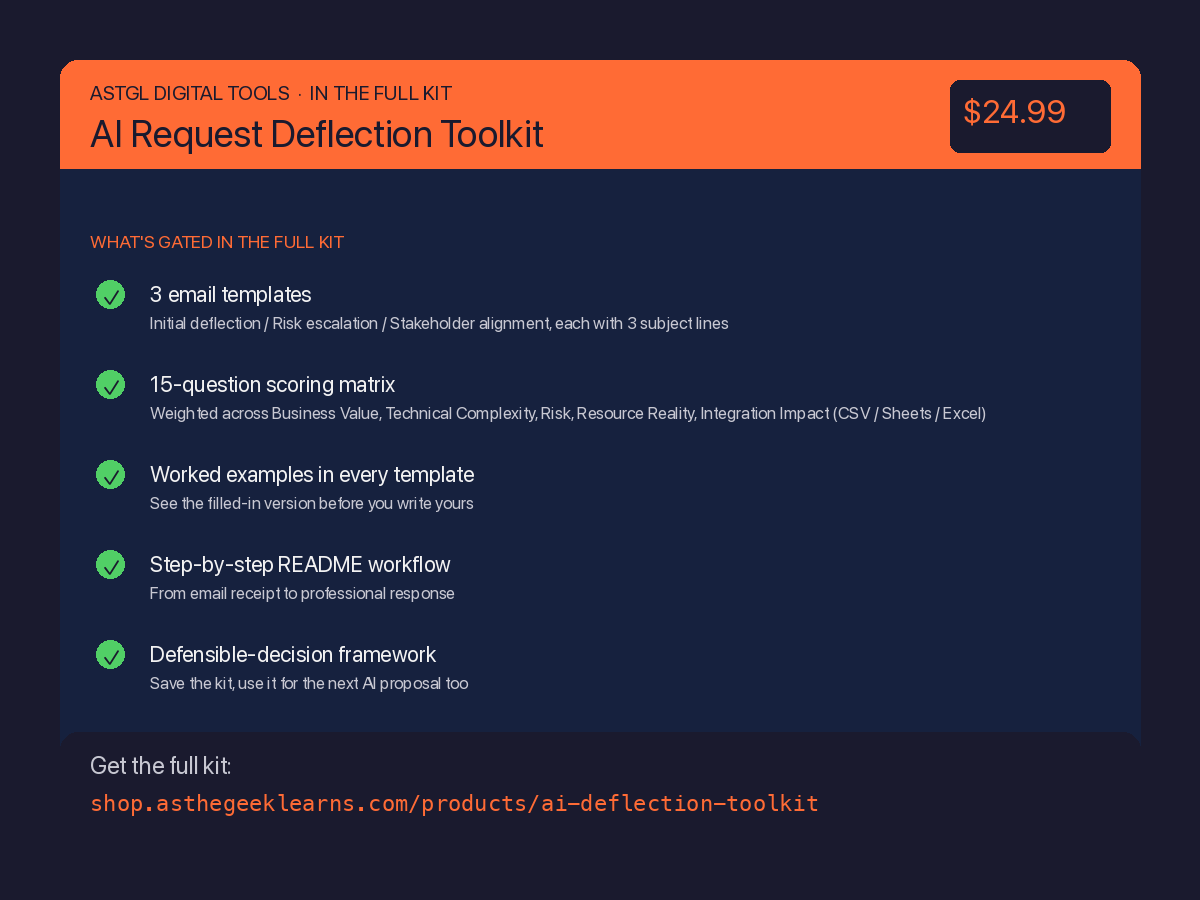
The complete AI Request Deflection Toolkit includes three email templates that turn your Reality Check findings into professional communications: an initial deflection that buys time while signaling genuine interest, a risk escalation that documents specific technical concerns in business-impact terms, and a stakeholder alignment template that ends the email thread and gets the right people in a room with a decision mandate. Every template has a filled-in worked example so you can see exactly what "adapted" looks like.
There's also a 15-question weighted scoring matrix in CSV and Sheets format. It turns "I have concerns" into "the proposal scores 41% against our evaluation criteria, which triggers a formal risk review." Objective. Defensible. Exportable. The kind of documentation that holds up in a post-project conversation.
And there's an escalation playbook for situations where the initial deflection didn't land and the project is being pushed forward without proper review. That one's for the harder conversations.
The Cost of Not Having a Process
Most IT managers who get burned by an executive-forwarded AI project didn't fail because the technology was bad. They failed because they said yes before they had answers, or they said no in a way that got overridden, or they said "we have concerns" without the documentation to back it up when the concerns turned out to be right.
A 15-minute structured evaluation is the cheapest investment in that problem. Run it every time. Document the answers. Keep the record.
If you want the full toolkit (the email templates, the scoring matrix, the escalation playbook, and all the worked examples), it's at the store for $24.99.
Get the AI Request Deflection Toolkit
The Technical Reality Check above is yours to use as-is. Print it. Keep it at your desk. The next email is coming.