


In Part 1 of this series, I shared my file organization disaster: years of digital chaos spread across four cloud services and two laptops. I discovered the Johnny Decimal system, a methodology that finally made sense, but I needed a tool to actually implement it across my sprawling reality.
So I decided to build one. But I’m a systems engineer, not a web developer. I can write PowerShell scripts in my sleep, but building a proper web application? Different skill set entirely.
This is where AI-assisted app development got interesting.
From AI Answers to AI Collaboration
I’d been using Claude, Anthropic’s AI assistant, for various work tasks. Technical documentation. Script debugging. Research. But I hadn’t explored what it would be like to build something with AI rather than just getting answers from it.
I started describing what I wanted: a web-based index for managing Johnny Decimal systems across multiple storage locations. Something accessible from any device. Something that would help me track not just where files should go, but where they currently are as I work through the migration.
What followed was genuinely collaborative. Not “AI writes code, human copies and pastes,” but an actual back-and-forth of designing, building, testing, and refining.
I’d describe a feature. Claude would propose an implementation. I’d test it, find edge cases, and explain what wasn’t working. We’d iterate. Sometimes I’d have a half-formed idea, and Claude would help me think through implications before writing any code.
I consider Claude a partner in this process. That’s not hype. It’s the most accurate description of how the work actually happened.
What JDex Does: A Johnny Decimal Index App
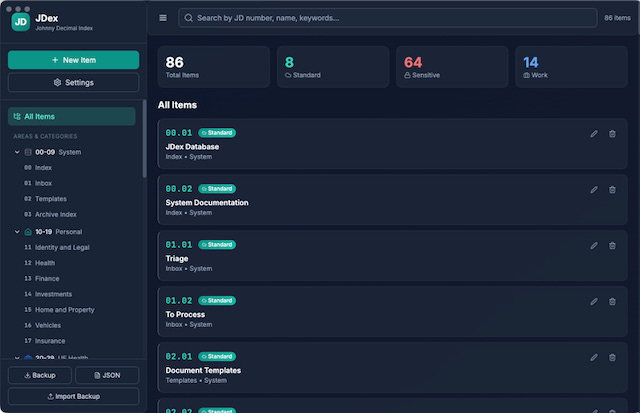
JDex is the Johnny Decimal index application that emerged from this collaboration. At its core, it lets you:
Define your structure: Create areas and categories that match how you think about your information.
Track locations: Note where files actually live, including which cloud service, which device, and which folder path.
Manage the index: The heart of Johnny Decimal is the index, a master reference of what exists and where it belongs.
Search and navigate: Find any ID quickly, see what’s in each category, and understand your system at a glance.
The working application matters, but what I learned about building with AI matters more.
4 Lessons from Building an App with Claude AI
1. AI collaboration is a skill
Like working with a human colleague, you get better at it. I learned to describe problems more clearly, break complex features into manageable pieces, and provide useful feedback when something wasn’t quite right. The quality of what Claude produced directly correlated with the quality of context I provided.
2. The human brings the context
Claude doesn’t know my file organization history, my workflow, or my pain points. I had to bring that context to every conversation. The AI could suggest solutions, but only I could evaluate whether they fit my actual life. Domain expertise isn’t replaced—it’s leveraged.
3. It’s genuinely faster
Things that would have taken weeks of learning web development frameworks happened in hours. Not because AI did all the work, but because it accelerated the parts I didn’t know while I focused on the parts I did. For a systems engineer exploring app development, this changes what’s possible.
4. The result feels like mine
This surprised me most. JDex isn’t something Claude built that I’m using. It emerged from hundreds of small decisions I made, issues I identified, and features I prioritized. The AI was a capable partner, but the vision and direction were always mine.
This article is also available in podcast format: The ASTGL Podcast
What's Next for JDex
JDex is functional but not finished. I’m using it daily as I implement my own Johnny Decimal system, and real-world usage keeps surfacing improvements.
I’ll be sharing more here on As The Geek Learns:
How I structured my Johnny Decimal system (decisions and tradeoffs)
Technical deep dives on JDex features
Lessons from migrating years of digital clutter
Honest assessments of where AI collaboration helps and where it doesn’t
We’re at an interesting moment with AI tools. Underneath the hype, there’s something real: people with ideas and domain expertise can build things that previously required skills they didn’t have.
I’m not a developer. But I had a clear problem, years of experience with organizational systems, and access to an AI that could help translate vision into working code. That’s a new kind of leverage worth exploring seriously.
JDex is my first real experiment in that space. It won’t be my last.
FAQ
What is JDex? JDex is a web-based application for managing Johnny Decimal file organization systems. It lets you define your category structure, track where files are stored across multiple locations, and maintain a searchable index of your entire system.
Do I need coding experience to use JDex? No. JDex is a user-facing application, not a coding tool. You interact with it through a web interface to manage your Johnny Decimal system.
Can I build an app with Claude AI if I’m not a developer? Yes, with cautions. You need enough technical literacy to test, debug, and direct the process. My background as a systems engineer helped. I understood logic and structure even without web development experience. Complete beginners would face a steeper learning curve.
Is JDex available to use? JDex is currently in development. Follow As The Geek Learns for updates on availability.
James is a systems engineer, writer, and builder. He publishes As The Geek Learns at astgl.com and writes about surveillance technology and democratic resistance at Resist and Rise.
Series: Building JDex
Part 1: The File Organization Problem
Part 2: How I Built JDex with Claude AI (You are here)
Part 3: Coming soon
Have you built anything with AI assistance? What was the collaboration actually like? Let me know in the comments.