


Writing one blog post is straightforward. Turning that post into a newsletter, social threads, SEO metadata, and platform-specific variations—that's where the hours disappear.
A content pipeline automates the repetitive parts so you focus on ideas, not formatting. Here's how to build one, from simple to fully autonomous.
The Short Answer
An AI content pipeline takes raw ideas and produces finished, distributed content through automated stages. The simplest pipeline has 3 stages. A production pipeline has 7 or more.
| Pipeline Level | Stages | Human Involvement | Output |
|---------------|--------|-------------------|--------|
| Basic | Write → Format → Publish | High—you drive every step | 1 article |
| Intermediate | Research → Write → Repurpose → Publish | Medium—review at checkpoints | 1 article + 10 derivatives |
| Advanced | Discover → Research → Write → Edit → Fact-check → Repurpose → Publish | Low—review final output | 1 article + 25+ derivatives |
Pipeline Architecture: The 7 Stages

Every content pipeline, regardless of complexity, follows the same logical stages. You can automate as many or as few as you want.
Stage 1: Discovery
What: Find topics worth writing about.
How: AI monitors news feeds, social media trends, competitor content, and search queries in your niche. It surfaces topics with high interest and low competition.
Manual version: You browse industry sites and note ideas.
Automated version: A scheduled agent searches 10+ sources daily and delivers a ranked topic list every morning.
Stage 2: Research
What: Gather information, data, and sources for the chosen topic.
How: AI searches the web, reads relevant articles, extracts key facts, and compiles a structured research brief.
Output: A 1-2 page brief with key points, statistics, source URLs, and suggested angles.
Stage 3: Drafting
What: Write the first draft.
How: AI takes the research brief, applies your voice profile and article template, and generates a full draft.
Critical input: A voice profile—a document that describes your writing style, preferred vocabulary, sentence patterns, and tone. Without this, AI output sounds generic. With it, the draft sounds like you.
Stage 4: Editing
What: Improve the draft's quality, flow, and accuracy.
How: AI reviews for clarity, removes filler, tightens sentences, checks structure against the template, and verifies the voice matches your profile.
This is best done as a separate pass with a different prompt than the drafting stage. A fresh "editor" perspective catches issues the "writer" misses.
Stage 5: Fact-Checking
What: Verify claims, statistics, and technical accuracy.
How: AI identifies every factual claim in the article, searches for supporting sources, flags anything unverified, and provides confidence ratings.
Two-phase approach:
1. Extraction: Pull every claim from the article
2. Verification: Check each claim against web sources and known data
This step catches hallucinations before they reach your audience.
Stage 6: Repurposing
What: Transform the article into platform-specific content pieces.
How: AI reads the finished article and generates variations for every distribution channel.
| Derivative | Platform | Format |
|-----------|----------|--------|
| 5 social posts | LinkedIn, X, Facebook, Instagram, Threads | Platform-native length and style |
| 5 short-form notes | Substack Notes | Teaser + link |
| 1 newsletter intro | Email | Hook paragraph + article link |
| 1 SEO document | Search engines | Meta description, keywords, schema markup |
| 1 voiceover script | Podcast / video | Conversational spoken version |
| 5 graphic suggestions | Design tools | Visual concepts with text overlays |
| 3 pull quotes | Social graphics | Shareable quote cards |
One article → 25+ content pieces. The marginal cost of each derivative is near zero.
Stage 7: Publishing
What: Distribute content to all channels.
How: Automated posting through APIs, MCP servers, or scheduling tools.
Current best practice: Publish to your own site first (canonical URL), then syndicate to Substack, social platforms, and newsletters. This is POSSE—Publish Own Site, Syndicate Everywhere.
Building Your First Pipeline
Start simple. You can always add stages.
Level 1: Manual Pipeline (30 Minutes)
Tools needed: Claude with filesystem MCP server.
1. Write an article (or paste an existing one)
2. Ask Claude: "Read this article and generate 5 LinkedIn posts, 5 tweets, a newsletter intro, and SEO metadata."
3. Review and publish manually
Time investment: 30 minutes per article cycle.
Output: 1 article + ~15 derivatives.
Level 2: Template Pipeline (15 Minutes)
Tools needed: Claude Code with custom commands.
Create a slash command (`.claude/commands/repurpose.md`) that contains your repurposing prompt with voice profile, platform specs, and output format. Then:
/repurpose path/to/article.mdOne command generates all derivatives. You review and publish.
Time investment: 15 minutes per article cycle.
Output: 1 article + 25+ derivatives.
Level 3: Automated Pipeline (5 Minutes of Review)
Tools needed: Local AI (Ollama), scheduling (OpenClaw/cron/n8n), MCP servers.
The pipeline runs on schedule:
1. Discovery agent finds a topic (or you assign one)
2. Research agent compiles a brief
3. Draft agent writes the article
4. Edit agent polishes it
5. Fact-check agent verifies claims
6. Repurpose agent generates derivatives
7. Draft appears in your review queue
Your only job: Read the final output, approve or request changes, hit publish.
Time investment: 5 minutes per article cycle (review only).
Output: 1 article + 25+ derivatives, fully automated.
Voice Profiles: The Secret to Human-Sounding AI Content
The #1 differentiator between generic AI content and content that sounds like you is the voice profile.
What a Voice Profile Contains
## Writing Voice: [Your Name]

### Tone
- Conversational but authoritative
- Direct — lead with the answer, not the preamble
- Practical over theoretical

### Sentence Structure
- Short sentences (10-15 words average)
- Active voice (95%+)
- Start paragraphs with statements, not questions

### Vocabulary
- Plain language — "use" not "utilize", "help" not "facilitate"
- Technical terms only when the audience expects them
- No corporate jargon: avoid "leverage", "synergy", "paradigm"

### Patterns to Follow
- Open with a hook that acknowledges the reader's problem
- Use tables for comparisons
- Include "How I Actually Do This" sections with real examples
- End FAQ sections with practical answers, not theory

### Patterns to Avoid
- Never use "In today's fast-paced world..."
- Never start with a definition from Wikipedia
- No filler paragraphs that don't add information
- Don't hedge excessively — state positions clearly
How to Build Your Voice Profile
1. Gather 5-10 pieces of your best writing—articles, emails, presentations
2. Ask AI to analyze your voice: "Read these writing samples and describe my writing style—tone, sentence structure, vocabulary choices, recurring patterns."
3. Edit the analysis—AI will capture 80%, you refine the rest
4. Include it in every content prompt—either inline or as a system prompt
How I Actually Do This
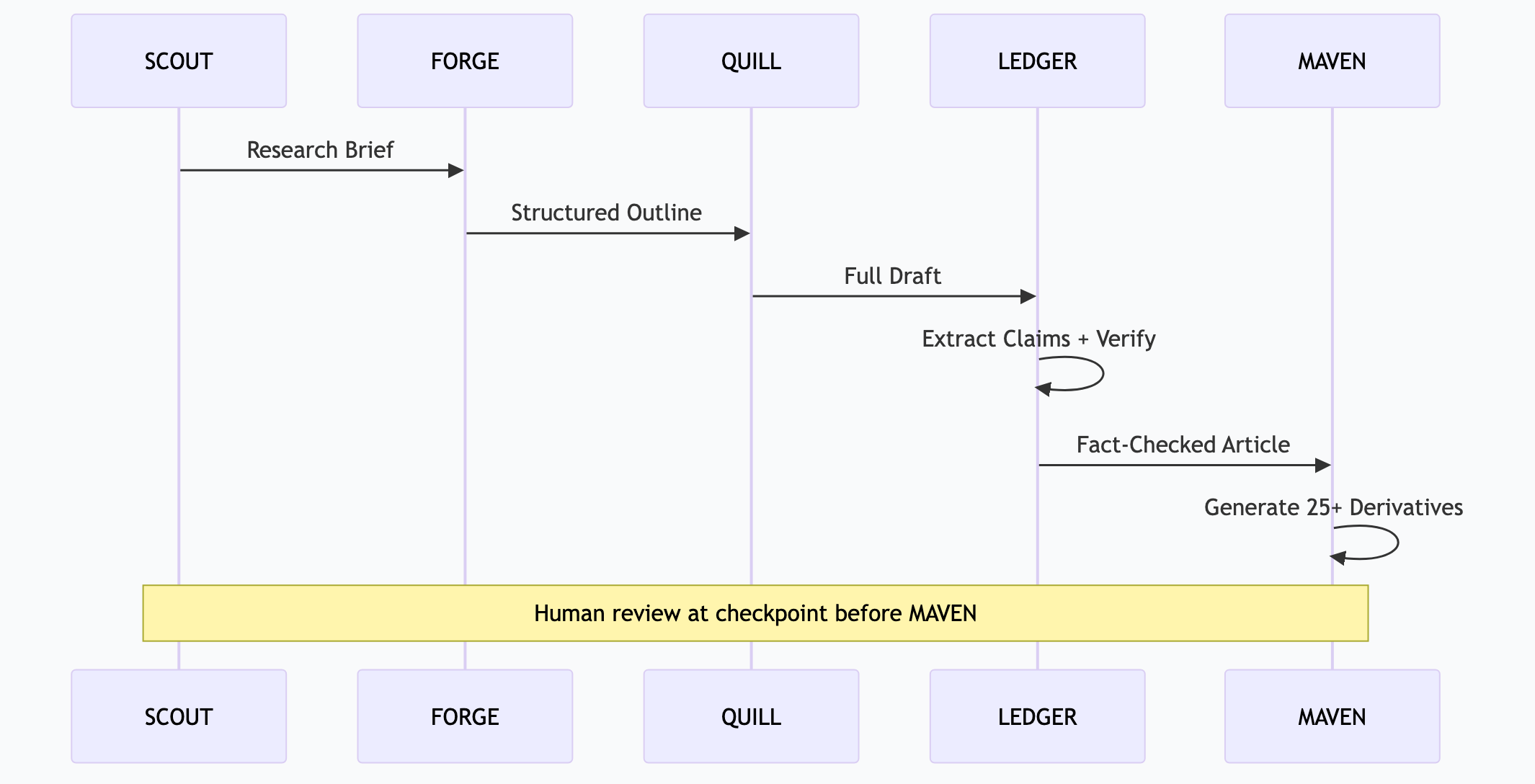
I run a multi-agent content pipeline called the ACA Council. Five specialized agents handle different stages:
The ACA Council
| Agent | Role | What It Does |
|-------|------|-------------|
| SCOUT | Discovery & Research | Monitors 15+ sources, surfaces trending topics, compiles research briefs |
| FORGE | Outlining & Structure | Takes research briefs and generates structured article outlines |
| QUILL | Drafting | Writes full articles following voice profile and article templates |
| LEDGER | Fact-Checking & Validation | Two-phase verification of every claim, flags uncertainties |
| MAVEN | SEO & Distribution | Generates all derivative content, optimizes for search and social |
The Daily Schedule
The Council meets twice daily:
Morning session (7 AM): SCOUT presents research, team prioritizes topics
Evening session (8 PM): Review completed articles, queue for publishing
The 7-Step Build Pipeline
For each article:
1. SCOUT delivers a research brief
2. FORGE generates the outline
3. QUILL writes the draft using voice profile
4. LEDGER fact-checks (two-phase: extract claims → verify sources)
5. Human review checkpoint (me—5 minutes)
6. MAVEN generates 25+ derivatives
7. Auto-publish to site, sync to Substack, queue social posts
Results
Output: 3-5 articles per week with full distribution packages
My time per article: ~10 minutes (topic approval + final review)
AI time per article: ~20 minutes of model compute
Cloud API cost: $0/month—everything runs on local Ollama models
Quality: Consistent voice, verified facts, platform-optimized distribution
Common Pipeline Mistakes
| Mistake | Why It Fails | Fix |
|---------|-------------|-----|
| No voice profile | Content sounds generic and robotic | Build a voice profile from your existing writing |
| Skipping fact-check | AI hallucinates statistics and quotes | Always run a verification pass before publishing |
| One-shot generation | Single prompt produces mediocre results | Split into stages—research, draft, edit are separate steps |
| No human review | Errors slip through, voice drifts | Always scan final output before publishing |
| Over-automating too early | Complex pipeline before simple one is proven | Start manual, automate one stage at a time |
Frequently Asked Questions
How long does it take to build a content pipeline?
A basic manual pipeline (Level 1) takes 30 minutes to set up. A template pipeline (Level 2) takes 1-2 hours. A fully automated pipeline (Level 3) takes 1-2 weeks of iterating on prompts, voice profiles, and scheduling. Start at Level 1 and upgrade when you feel the friction.
Will Google penalize AI-generated content?
Google penalizes low-quality content, regardless of how it's created. AI content that's well-researched, accurate, and genuinely useful ranks well. The key factors: original insights (your "How I Actually Do This" sections), verified facts, and genuine expertise. A pipeline that produces generic AI slop will be penalized. One that produces expert-informed, fact-checked content won't.
Can I use this for client work?
Yes, with transparency. Many agencies use AI pipelines to increase throughput. The ethical approach: AI handles research, drafting, and repurposing; humans provide expertise, review, and final approval. Disclose AI assistance if your clients expect it.
How do I handle topics the AI gets wrong?
This is why the fact-checking stage exists. For technical topics, include authoritative sources in the research brief so the AI has correct information to work from. For evolving topics, always include a web search step to get current data. And always review—the pipeline produces drafts, not published pieces.
What's the best AI model for content pipelines?
For drafting: Gemma 4 26B or 31B (best voice quality at the local tier). For fact-checking: a model with web search access. For repurposing: Gemma 4 26B (handles format transformation well). For the full pipeline on a budget: a single Gemma 4 26B handles all stages adequately.
*This is part of the ASTGL Definitive Answers series—structured, practical answers to the questions people actually ask about AI automation, MCP servers, and local AI infrastructure.*