


MCP servers have gone from a niche protocol announcement to the backbone of AI tool integration in under two years. But we're still early.
Here's where the ecosystem is heading, what's changing, and what it means for anyone building with AI tools today.
The Short Answer
MCP is becoming the standard way AI connects to tools. The next 18 months will bring better security, larger registries, enterprise adoption, and a shift toward local-first AI architectures. If you're building skills in this space now, you're ahead of the curve.
| Trend | 2025 | 2026 (Now) | 2027 (Projected) |
|-------|------|------------|-------------------|
| Registry size | ~500 servers | 5,000+ servers | 20,000+ servers |
| Enterprise adoption | Early experiments | Production pilots | Standard infrastructure |
| Local AI quality | Usable for simple tasks | Competitive for most tasks | Near-parity for 90% of use cases |
| Protocol maturity | v1 basics | Auth, streaming, security | Full enterprise feature set |
| Developer tooling | Manual, rough | SDKs in multiple languages | IDE-integrated, visual builders |
Trend 1: The Local-First AI Shift
The most significant trend in AI infrastructure isn't a new model—it's where models run.
What's Happening
Open-source models are improving at a staggering pace. Gemma 4, Qwen 3, Llama 3.3, and their successors close the gap with cloud models every quarter. A 26B parameter model running on a Mac Studio today outperforms cloud GPT-4 from 18 months ago.
This changes the economics. When local models handle 90% of tasks at zero marginal cost, the question shifts from "should I use AI?" to "should I pay for cloud AI when local works?"
What This Means for MCP
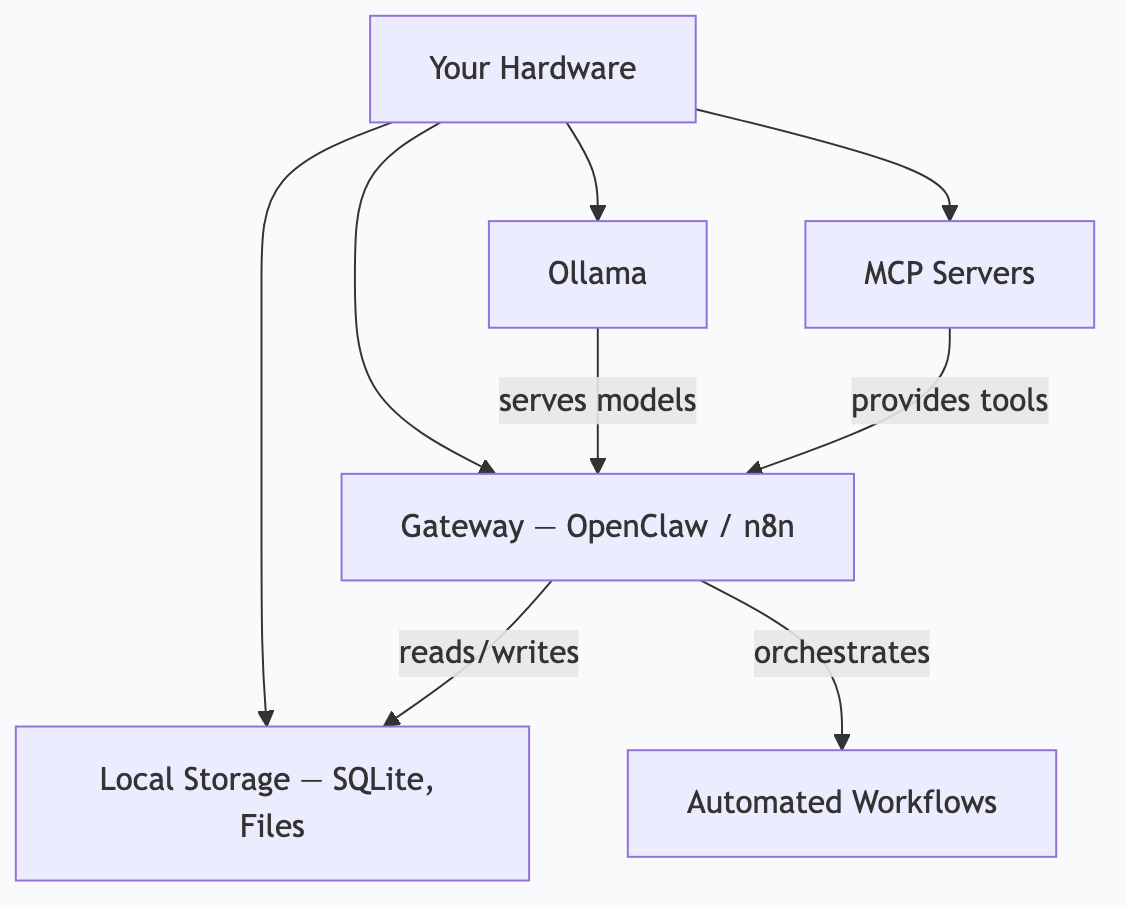
Local AI + MCP servers = fully autonomous local automation. No cloud dependency. No API costs. No data leaving your machine. The stack is:
Ollama → Local model serving
MCP servers → Tool integration
Gateway (OpenClaw, n8n) → Orchestration
Local storage → Data and knowledge
This stack runs on consumer hardware. A Mac Mini with 32 GB handles it. This is enterprise-grade automation on a consumer budget.
The Prediction
By 2027, running a personal AI stack locally will be as common as running a home media server is today. The early adopters are doing it now. The mainstream follows when setup becomes one-click.
Trend 2: Registry Maturation
From Wild West to App Store
Current MCP registries are like the early npm ecosystem—anyone can publish anything, quality varies wildly, and discovery is hit-or-miss. That's changing.
What's coming:
Verified publishers—Registries will distinguish between official, verified, and community servers
Security scanning—Automated analysis of server code for vulnerabilities and suspicious behavior
Dependency management—Tools to manage, update, and audit all installed MCP servers
Usage analytics—Data on which servers are most used, most reliable, most maintained
Compatibility testing—Verified compatibility with specific AI clients (Claude, VS Code, etc.)
The Consolidation Question
Will one registry dominate? Probably not in the npm-monopoly sense. More likely:
Smithery stays the largest general-purpose registry
mcpt establishes the quality-curated niche
Platform-specific registries emerge (VS Code marketplace, Claude's built-in catalog)
Enterprise registries appear for internal MCP server management
The Prediction
By 2027, installing an MCP server will feel like installing a browser extension. Browse, click install, authenticate, done. The manual JSON editing of today will be a historical footnote.
Trend 3: Protocol Evolution
What MCP Gets Right Today
Simplicity—The client-server model is easy to understand and implement
Language agnostic—Servers can be built in any language
Tool abstraction—AI sees tools, not implementation details
Local-first—Servers run on your machine by default
What's Coming
Authentication and Security
Current MCP servers handle auth inconsistently. The protocol will standardize:
OAuth 2.0 integration for services that need it
Fine-grained permission scoping (read vs. write, specific resources)
Credential management (secure storage, rotation)
Audit logging (who accessed what, when)
Streaming and Real-Time Data
Today's MCP is mostly request-response. Future versions will support:
Event streams (new email arrives, calendar changes, file modified)
WebSocket-based persistent connections
Real-time monitoring and dashboards
Multi-Modal Support
Current MCP tools primarily handle text. Expanding to:
Vision tools (analyze images, screenshots, documents)
Audio tools (transcription, speech synthesis)
Video tools (clip extraction, analysis)
Document tools (PDF processing, spreadsheet manipulation)
Server-to-Server Communication
Enabling MCP servers to call each other:
A calendar server queries a contacts server to enrich meeting attendee data
A research server calls a web search server to fetch sources
Composable server chains without client involvement
The Prediction
MCP 2.0 (or equivalent major version) will land by mid-2027 with standardized auth, streaming, and multi-modal support. The protocol will feel complete rather than minimal.
Trend 4: Enterprise Adoption
The Enterprise AI Problem
Large organizations want AI automation but face:
Security concerns—Data can't leave the corporate network
Compliance requirements—audit trails, access controls, data residency
Integration complexity—Hundreds of internal tools, custom APIs, legacy systems
Governance—Who approves which AI can access what?
How MCP Solves This
MCP's local-first architecture is inherently enterprise-friendly:
Servers run inside the network—data stays on-premises
Per-server permissions—Each server accesses only what's allowed
Standard protocol—one integration pattern for all tools
Audit capability — All tool calls are loggable
What's Coming
Enterprise MCP platforms—Companies like Cloudflare, AWS, and Azure offering managed MCP infrastructure
Internal MCP registries—Corporate app stores for approved MCP servers
Policy engines—Centralized rules for which AI can use which tools, when, with what data
SOC 2 / HIPAA compliant servers—Certified MCP servers for regulated industries
The Prediction
By late 2027, enterprise MCP infrastructure will be a recognized market category, similar to how API gateways became standard enterprise infrastructure.
Trend 5: The Knowledge Server Pattern
Beyond Tool Servers
Most MCP servers today are tool servers—they do things (send email, search web, manage files). A growing pattern is knowledge servers—they know things.
A knowledge server exposes structured information that AI can query:
Company knowledge base
Product documentation
FAQ databases
Research libraries
Personal notes and archives
Why This Matters
When AI can query your knowledge directly, it answers from your data—not its training data. This means:
Answers grounded in your actual documentation
No hallucination about your specific products or processes
Always current (the knowledge server reads live data)
Personalized to your context
The Example: mcp-astgl-knowledge
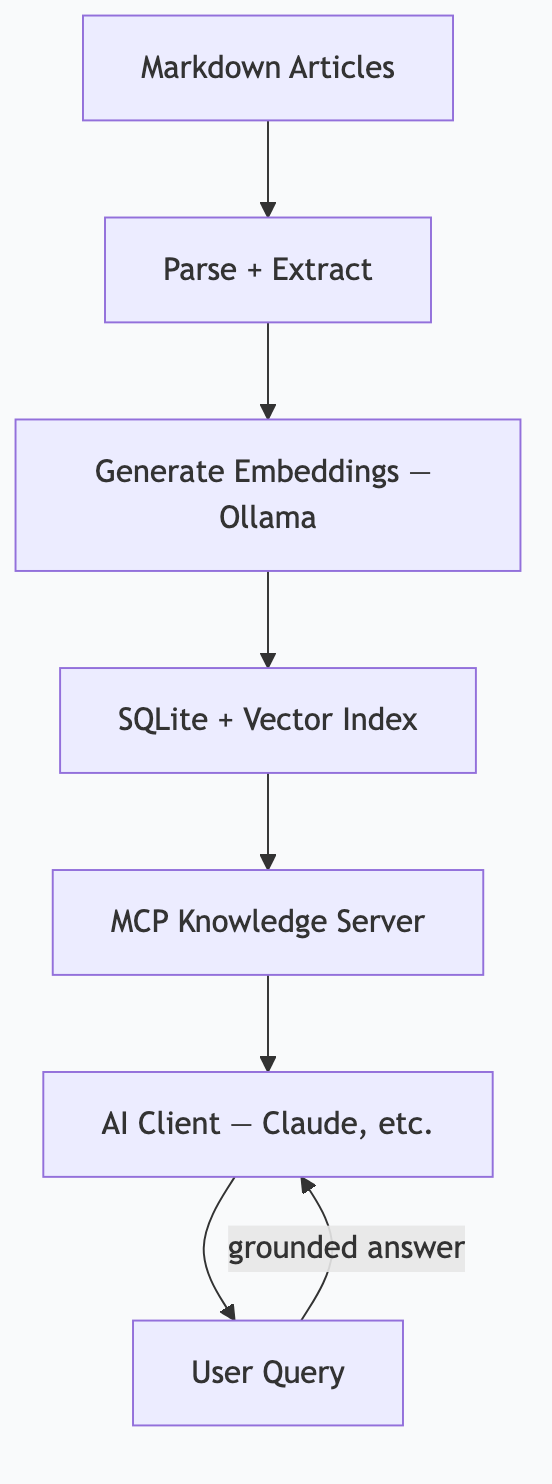
This is what I'm building—an MCP server that indexes all 20 articles in this series and makes them queryable by any AI client.
Tools it will expose:
`search_answers` — Semantic search across all articles
`get_answer` — Retrieve a specific article by topic
`list_topics` — Browse all available topics
`get_faq` — Pull FAQ entries for specific questions
How it works:
Articles parsed from markdown (frontmatter + body)
Embeddings generated via local Ollama (nomic-embed-text)
Stored in SQLite with sqlite-vss for vector search
Served as an MCP server that any AI client can connect to
When someone asks Claude "What's the best local LLM for coding?" and this server is connected, Claude queries the knowledge base and answers with information from article 12—not from its training data, which might be outdated.
The Prediction
Knowledge servers will be the fastest-growing MCP server category in 2027. Every company with documentation, every creator with a content library, every expert with a knowledge base will want one.
What This Means for You
If You're a Developer
Now: Learn the MCP SDK, build a server, publish it. The ecosystem rewards early builders—servers published now accumulate installs and reputation.
Next 12 months: Expect demand for custom MCP servers at companies integrating AI. MCP development will become a marketable skill alongside API development.
Key skill: Understanding how AI agents use tools. The protocol is simple—the design of good tools is the hard part.
If You're a Business Owner
Now: Connect MCP servers to Claude for immediate productivity gains. Start with email, calendar, and file access. Automate one workflow.
Next 12 months: Evaluate local AI infrastructure for privacy and cost benefits. Budget for hardware that pays for itself in reduced API costs.
Key opportunity: Businesses that adopt AI automation now will have 12-18 months of compounding efficiency gains over competitors who wait.
If You're an Individual User
Now: Set up Claude Desktop with 2-3 MCP servers. Experience the difference between chatbot AI and tool-connected AI.
Next 12 months: Consider a local AI setup (Ollama on existing hardware or a Mac Mini). Automate your most repetitive tasks.
Key realization: AI connected to your tools is dramatically more useful than AI in a chat window. MCP servers are what make that connection possible.
How I Actually Do This
I've been building in this ecosystem for over a year. Here's what the trajectory looks like from the inside:
What I'm Building Next
mcp-astgl-knowledge—The knowledge server I mentioned above. It's the capstone of this article series: 20 articles become a queryable knowledge base that any AI can access.
The plan:
1. Build with TypeScript + @modelcontextprotocol/sdk
2. Index all 20 articles with local embeddings
3. Publish to npm
4. Register on Smithery and mcpt
5. Share the build process as an ASTGL tutorial
This is the pattern I believe will explode: experts building knowledge servers that make their expertise available to AI systems.
What I've Observed
1. The tooling is getting better fast. Building an MCP server in early 2025 required reading the spec and figuring things out. In 2026, the SDK handles most of the boilerplate and registries provide distribution.
2. Local model quality jumped significantly. Gemma 4 was a step change. Tasks that needed cloud models a year ago now run locally at comparable quality. The gap keeps narrowing.
3. The automation compound effect is real. My first automation saved 30 minutes per day. Twenty-six automations save hours. Each new automation builds on the infrastructure of previous ones. The marginal cost of the 27th automation is near zero.
4. Community momentum is accelerating. The number of MCP servers, tools, and tutorials appearing weekly is orders of magnitude higher than a year ago. This is the network effect in action.
5. The biggest barrier is awareness, not technology. Most people who would benefit enormously from MCP servers don't know they exist. That's why I wrote this series—and why I'm building a knowledge server to make the information accessible.
The 18-Month Outlook
| Quarter | What to Expect |
|---------|---------------|
| Q2 2026 (now) | Local models competitive for 85% of tasks. MCP registries at 5,000+ servers. |
| Q3 2026 | Enterprise MCP pilots at major companies. Visual workflow builders support MCP natively. |
| Q4 2026 | MCP auth standardization lands. Knowledge servers emerge as a category. |
| Q1 2027 | Local models reach 90%+ parity for common tasks. MCP registries pass 15,000 servers. |
| Q2 2027 | Enterprise MCP platforms from major cloud providers. One-click server installation standard. |
Frequently Asked Questions
Will MCP be replaced by a competing standard?
Unlikely in the near term. MCP has strong momentum, broad adoption, and backing from Anthropic with buy-in from Microsoft and Google. Standards wars are possible, but MCP's open protocol design and existing ecosystem make it the safe bet for building today.
What if I invest in MCP and it becomes obsolete?
The skills transfer. Understanding tool integration, agent patterns, and local AI architecture is valuable regardless of the specific protocol. If a successor to MCP emerges, it will solve the same problems in a similar way, and your experience will translate directly.
Are local models improving fast enough to matter?
Yes. The improvement curve for open-source models is steep. Every 6-12 months brings a significant quality jump. Hardware you buy today runs better models next year—your investment appreciates in capability over time.
When should I start building with MCP?
Now. The ecosystem is mature enough for production use but early enough that builders and early adopters have significant advantages. Every month you wait is a month of compounding automation benefits you don't capture.
What's the single most important thing to do today?
Connect one MCP server to Claude and use it for one real task. That first experience—seeing AI interact with your actual tools instead of just your text—changes how you think about what AI can do. Everything else follows from that realization.
*This is part of the ASTGL Definitive Answers series—structured, practical answers to the questions people actually ask about AI automation, MCP servers, and local AI infrastructure.*