


You set up an autonomous agent to check a status page, summarize a log file, or score an incoming request every fifteen minutes. It works. You move on. Three weeks later you're staring at an API bill wondering where the money went, and the answer is: every one of those checks quietly called a paid model because that's what the scaffolding defaulted to.
The Setup
Here's how it happens. You're building your first cron job or headless agent, and you reach for the model you already have configured: your API key, your existing client, the one you use every day in your interactive coding sessions. It's the path of least resistance. The job works on the first try, the output looks fine, and you ship it.
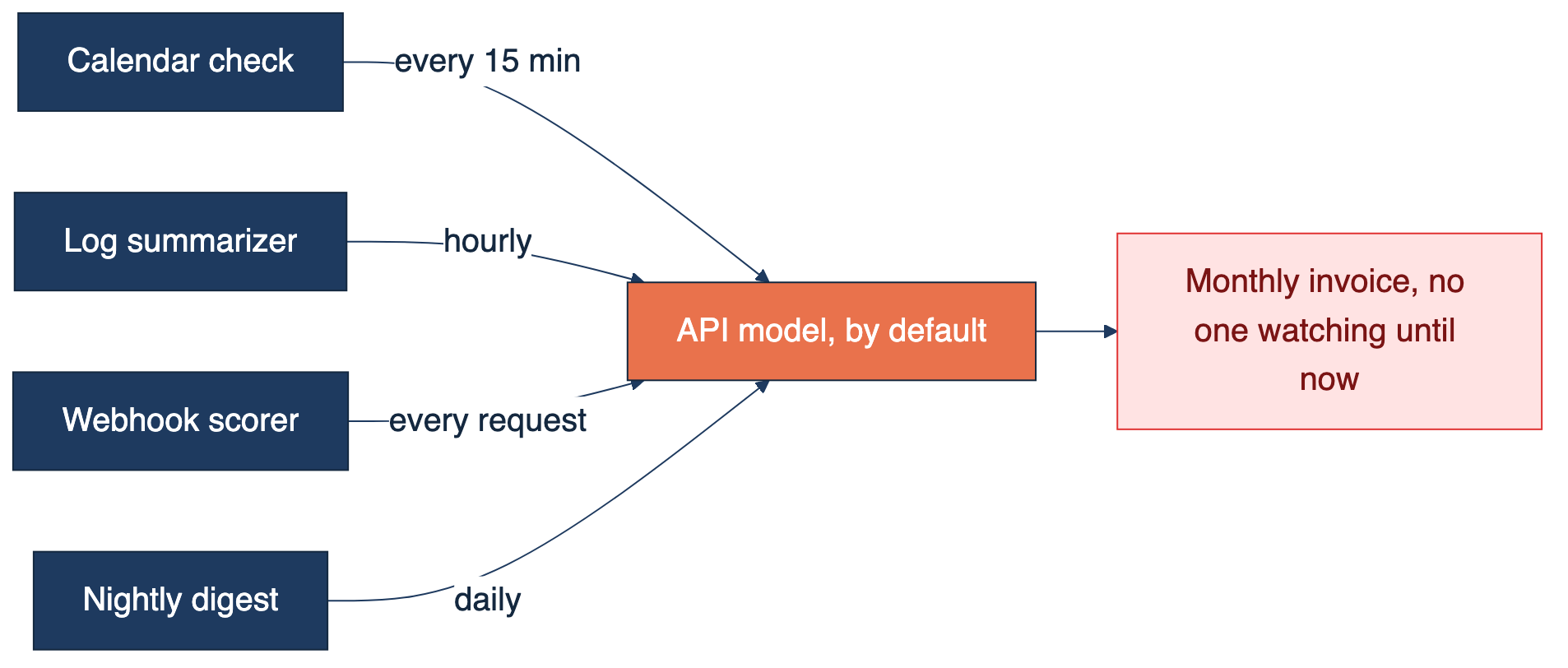
Now do that four more times. A calendar check here, a log summarizer there, a scoring pass on incoming webhooks, a nightly digest job. Each one is trivial in isolation, a few cents per run. None of them individually looks worth optimizing. But cron jobs don't run once. They run every fifteen minutes, every hour, every night, forever, and nobody's watching a dashboard for "aggregate cost of five small automations." You only notice when the monthly total shows up somewhere you're already looking, like a billing email.
What's Actually Going On
This isn't a pricing problem. It's a defaults problem. When you're building interactively, using the strongest model available makes sense: you're paying for judgment, nuance, and the ability to handle a task you haven't fully specified yet. But a cron job isn't interactive. It runs unattended, on a fixed schedule, doing the same narrow task every time. Most of that work doesn't need frontier-model reasoning. It needs “Did this text contain the word 'error'" or “Summarize these five bullet points" or “Does this value fall outside a threshold."
The trap is that nobody makes an explicit decision to use the expensive model for ops work. It's just what the code already had wired up. Reliability worries make this worse: the first time a local model flakes or a self-hosted endpoint times out, the instinct is to blame the model and switch back to the API default rather than debug the actual cause, and once that switch flips, it rarely gets revisited.
Treating local-versus-API as a deliberate architectural decision, made once per task class instead of once per project, is what closes the gap.
The Fix
Most tools that call an LLM API, whether it's a summarizer CLI, a LangChain chain, or your own scripts, are built against the OpenAI-compatible chat completions format. If you're running Ollama locally, it already exposes that exact interface, so redirecting a tool to a local model is usually a base URL change, not a rewrite:


Point that at whichever local model you're running, gemma4:31b-mlx or whatever's current in your Ollama pull list, and any OpenAI-SDK-based tool talks to it without touching its own code. That's the mechanism. The decision layer on top of it is a simple tier:
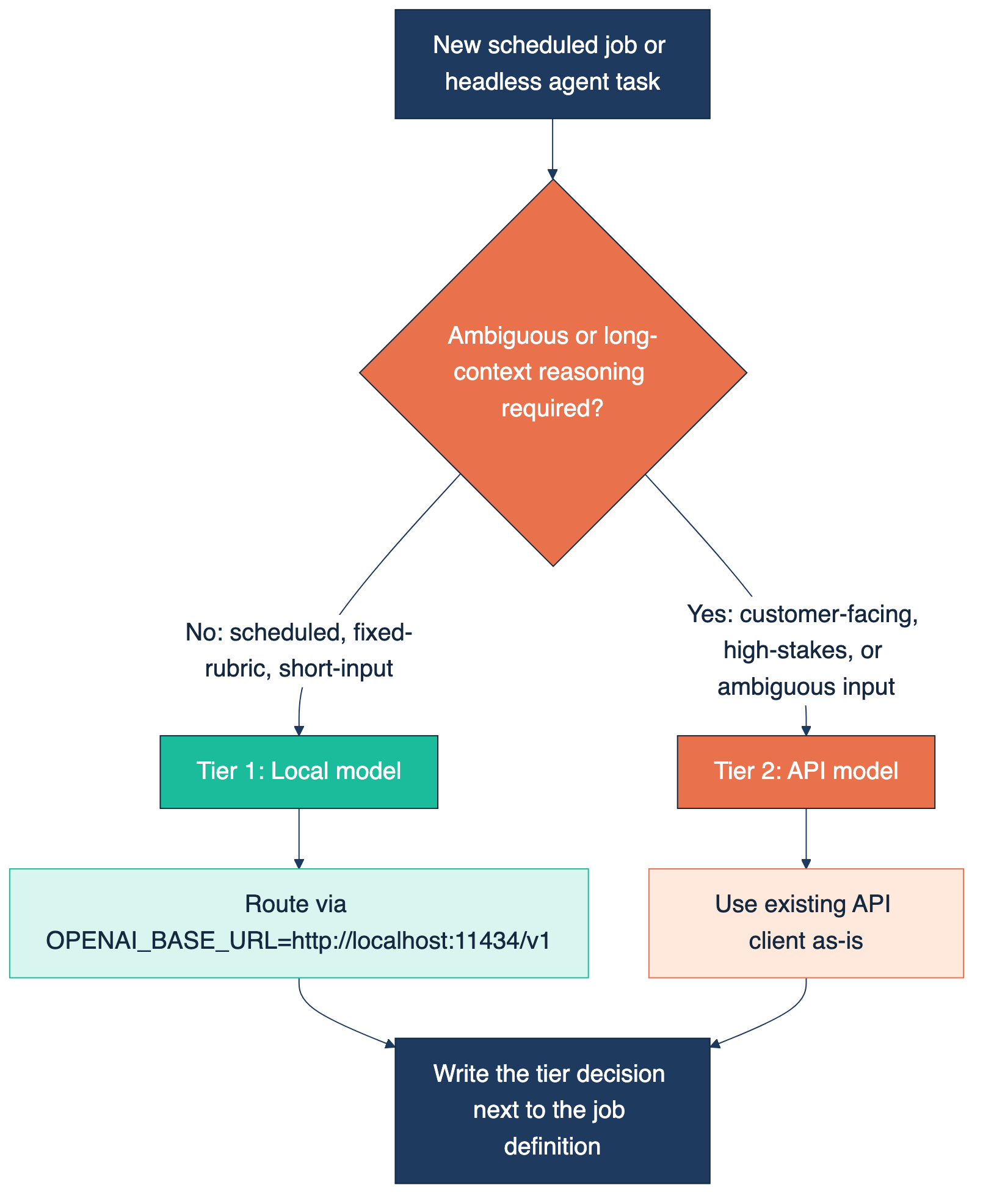
Tier 1, local by default: anything scheduled and unattended, anything scoring or classifying against a fixed rubric, anything summarizing structured or short-form input. This is nearly every cron job.
Tier 2, API on escalation: tasks that need genuine reasoning over ambiguous or long-context input, anything customer-facing where a wrong answer is costly, anything you'd want a second opinion on if a human were doing it.
Write the tier assignment down next to the job definition, not just in your head. When you add a new cron, the question isn't "which model do I already have a key for," it's "which tier does this task belong to." That written-down rule is what keeps you from relitigating the same defaults decision every time you copy-paste a cron.
Why This Matters
The pattern extends past cost. Any unattended process that runs on a schedule, not just LLM calls, tends to inherit whatever configuration was easiest at creation time rather than what the task actually needs, and nobody revisits it because it isn't failing loudly. Cost is just the failure mode that happens to show up on an invoice instead of in an error log. If you're building a fleet of small agents or cron-driven automations, the same discipline applies to any resource you can over-provision by default: compute tier, retry budget, context window, and concurrency. Unattended work needs its defaults set on purpose because nothing else is going to flag it for you.

The other half of this is treating local-versus-API as a real architectural question instead of a reflex. If a job flakes, that's worth investigating on its own terms, not a reason to fall back to whichever model has a company card behind it. The reflex, not the model, is usually the expensive part.
Quick Reference
Default new cron jobs and headless agents to a local model; escalate deliberately, not by habit
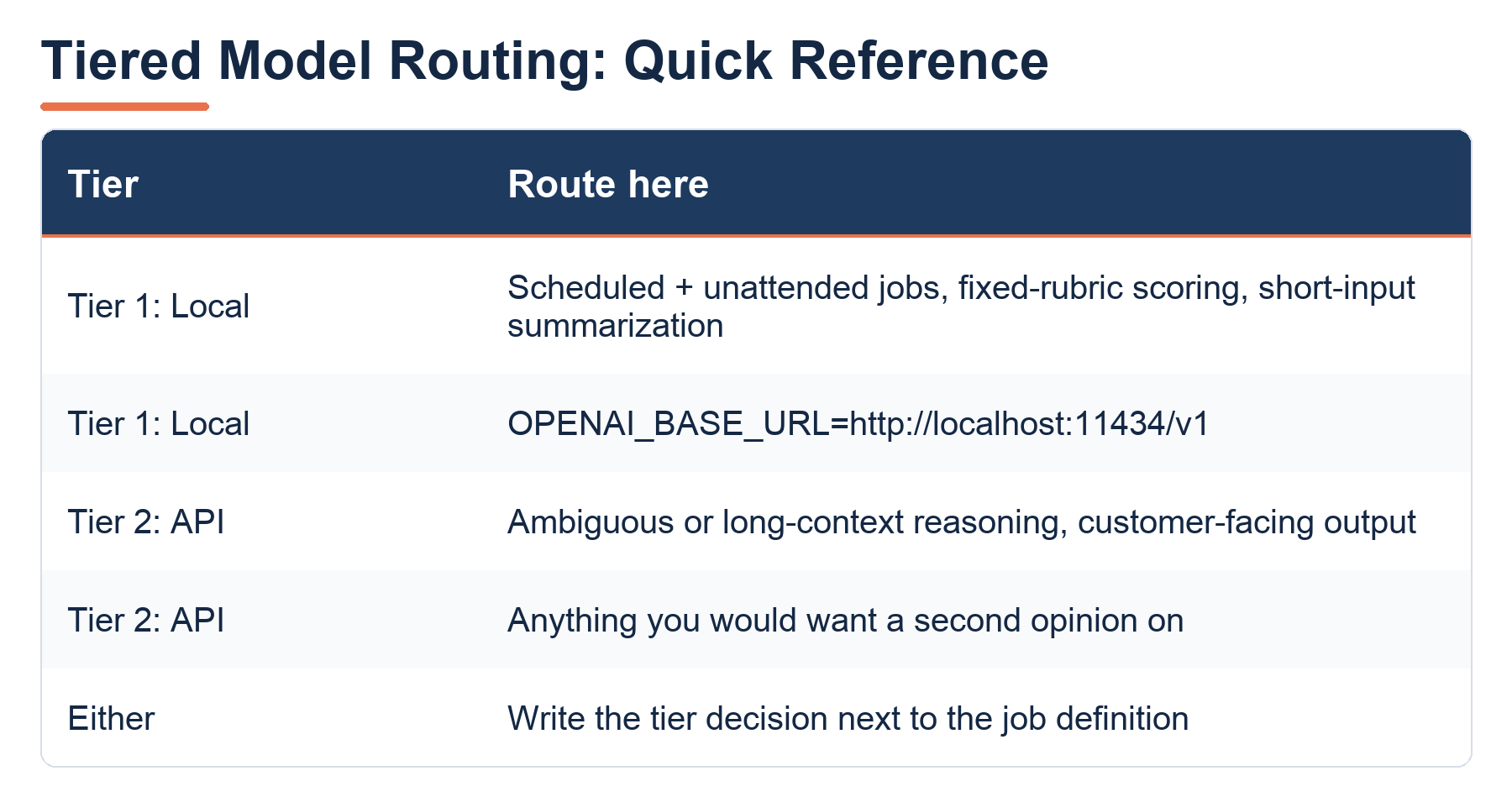
Route OpenAI-compatible tools to Ollama with
OPENAI_BASE_URL=http://localhost:11434/v1Tier 1 (local): scheduled, unattended, fixed-rubric scoring, short-input summarization
Tier 2 (API): ambiguous or long-context reasoning, customer-facing output, anything you'd want a second opinion on
Treat "the local model seems unreliable" as a question to investigate, not a reason to reflexively fall back to the API
Write the tier decision down next to the job definition so it doesn't get silently overridden later
Found this useful? I share practical lessons from my systems engineering journey at As The Geek Learns
Frequently Asked Questions
What does “tiered model routing” mean for AI agents?
It means assigning scheduled or unattended tasks to a cheap or local model by default, and reserving paid API models for work that genuinely needs deeper reasoning, instead of defaulting every task to whatever model your interactive tooling already uses.
Source: ASTGL Analysis
Why do API costs from cron jobs sneak up on you?
A job that costs a few cents per run adds up across dozens or hundreds of scheduled runs, and nothing surfaces the running total unless you’re specifically watching a billing dashboard for it.
Source: ASTGL Analysis

Does Ollama support the OpenAI API format?
Yes. Ollama exposes an OpenAI-compatible chat completions endpoint at `http://localhost:11434/v1` and accepts any placeholder value as the API key, so OpenAI-SDK-based tools can point at it with just a base-URL change.
Source: https://ollama.com/blog/openai-compatibility
What kinds of tasks are safe to route to a local model?
Scheduled, unattended tasks with a narrow job: fixed-rubric scoring, short-input summarization, calendar or status checks, and anything where the same input should reliably produce the same category of output.
Source: ASTGL Analysis
When should an agent escalate to a paid API model instead?
When the task needs genuine reasoning over ambiguous or long-context input, is customer-facing where a wrong answer is costly, or is the kind of judgment call you’d want a second opinion on if a human were doing it.
Source: ASTGL Analysis
My local model seems unreliable; should I switch back to the API?
Investigate it as its own problem before you reach for the reflex switch. Falling back to the paid API by habit every time a local model flakes is exactly the defaults problem this article describes, and the reflex is usually the more expensive part, not the model.
Source: ASTGL Analysis