



You probably have agents or workflows calling Claude Fable 5 right now because it’s been included in your subscription. That free window closes in six days. Instead of panic-switching everything or ignoring the bill, there is a calm way to decide what stays and what moves.
The clock that’s actually ticking
The deadline is firm: July 19, 2026, at 11:59:59 PM PT. Until then, if you are on a Pro, Max, Team, or premium Enterprise plan, you can use Fable 5 for up to 50% of your weekly usage limits without extra charges. After that, continued use requires prepaid credits at $10 per million input tokens and $50 per million output tokens.
Anthropic has extended this window three times in five weeks. The original paywall was June 22, then July 7, then July 12, and now July 19. While they say the credit-billing arrangement is temporary and they’ll return Fable 5 to standard subscriptions when compute capacity allows, there is no timeline for that. These repeated extensions are a signal that Anthropic is capacity-constrained. Plan as if July 19 is the final date.
This is a routing problem, not a loss
It’s easy to feel like you’re losing a tool, but for most of us, this is actually a routing problem. Most of the work we send to Fable 5 doesn’t actually need Fable 5. We tend to pin the “best” model by default because it’s available and free, regardless of whether the task requires that level of reasoning.
The fix isn’t a global switch to a cheaper model; it’s routing per task. You don’t need a sledgehammer to hang a picture frame. By identifying which tasks truly require high-reasoning capabilities and which are just “good enough” for mid-tier models, you can maintain your quality while keeping your costs low.

The six-day checklist
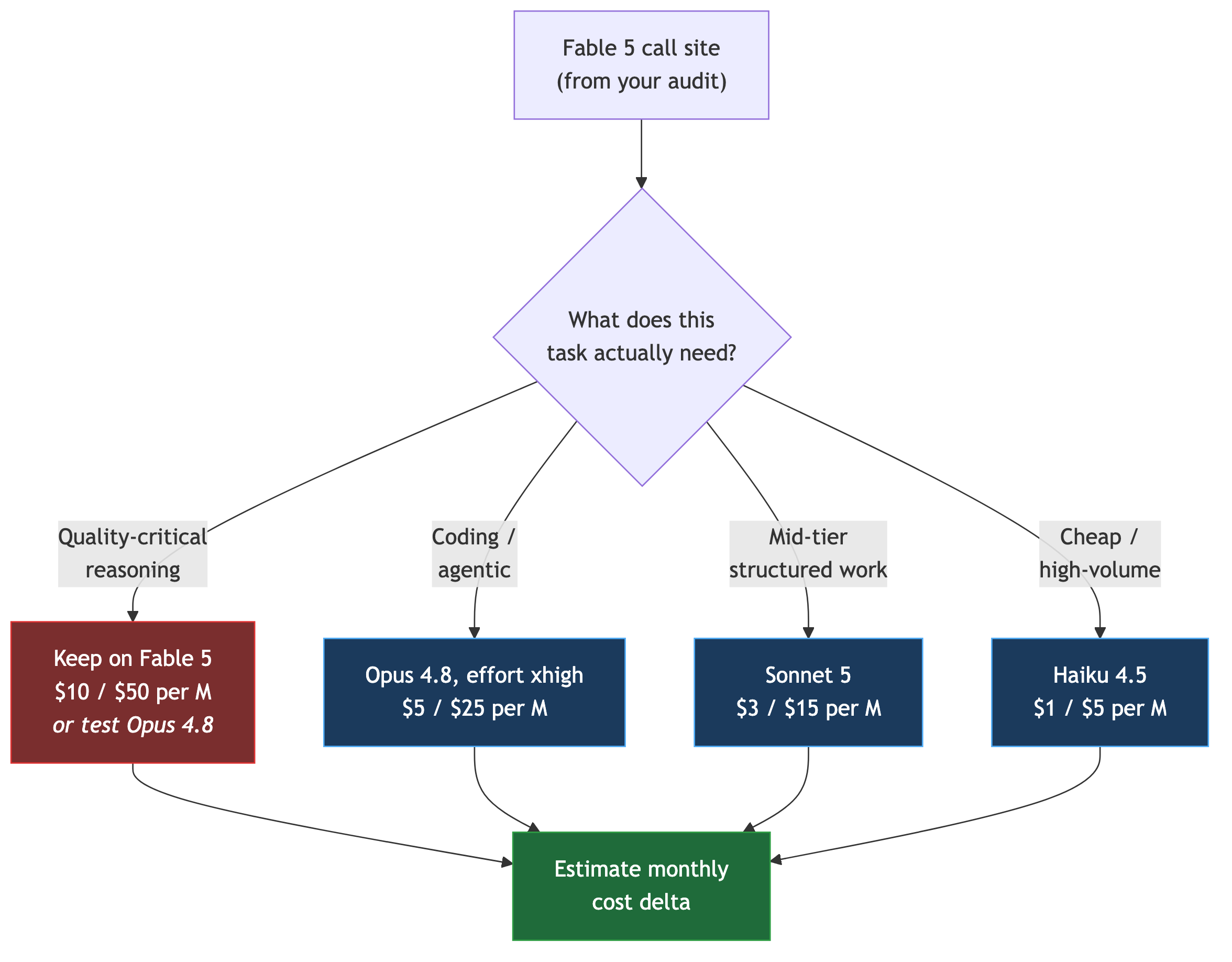
You can handle this migration in four steps. Don’t do it globally; do it per call site.
1. Audit your call sites
Start by finding every place where your code or config pins Fable 5. Grep your environment variables, agent definitions, and launch scripts for “fable” or the model ID claude-fable-5. You’ll likely find that you’ve pinned it in fewer places than you remember, but also in a few places reflexively just because it was the top option. List every single call site.
2. Classify by capability
Be honest about what each task actually needs. Sort each call site into three buckets:
Quality-critical reasoning: This is for hard multi-step logic, long-horizon autonomous runs, or tasks where a wrong answer costs you real money or hours of debugging. These genuinely want Fable 5 or Opus 4.8.
Mid-tier: Most coding, tool-heavy workflows, and structured data work fall here. Opus 4.8 or Sonnet 5 handle these effectively.
Cheap/high-volume: Simple classification, extraction, routing, or basic lookups. These belong on Haiku 4.5.
3. Substitute per task
Now map those buckets to specific models. This is where you save the most money.
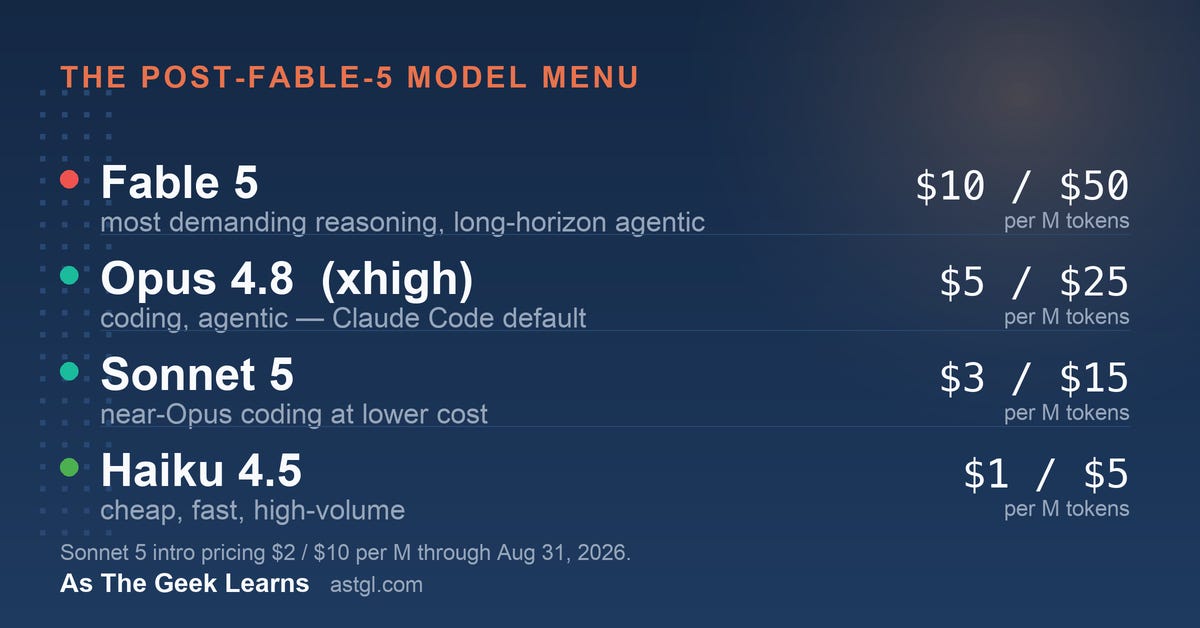
For coding and agentic work, move to Claude Opus 4.8 (claude-opus-4-8) using effort xhigh. This is Anthropic’s own recommendation for coding (and it’s the default for Claude Code). It costs $5 per million input and $25 per million output, which is exactly half the cost of Fable 5.
For mid-tier work, use Sonnet 5 (claude-sonnet-5). It offers near-Opus quality at a lower price point: $3 per million input and $15 per million output (though there’s intro pricing of $2/$10 through August 31, 2026).
For high-volume, simple tasks, use Haiku 4.5 (claude-haiku-4-5). It’s the fastest and cheapest option at $1 per million input and $5 per million output.
For those few quality-critical tasks, you can either keep them on Fable 5 and budget for the credits or step them down to Opus 4.8 and measure if the quality gap actually affects your specific workload. Don’t assume it does; test it.
4. Estimate the monthly cost delta
For any task you decide to keep on Fable 5, estimate your monthly token volume and multiply by $10/M input and $50/M output. That number is what the free window has been hiding from you. When you route everything else down to Opus or Sonnet, the cost becomes a fraction of that. The mistake is defaulting your entire fleet to Fable 5; keeping one or two critical tasks there while routing the rest is usually very affordable.
What about jumping ship to Sol?
If you’re already re-evaluating your stack and your agents are pure coding agents, it’s worth looking at OpenAI’s GPT-5.6 Sol. It launched on July 9th, and OpenAI reports state-of-the-art coding results, claiming Sol outperforms competing frontier models (Claude included) at a lower cost. Just remember that Sol is an outside option from OpenAI, not part of the Claude-native ecosystem. It’s a strong cross-provider alternative if your primary metric is coding benchmark performance.

Why this matters
The migration you do this week isn’t just about avoiding a bill; it’s the first draft of a permanent model-routing layer. Relying on a single “best” model is a fragile strategy. The durable answer is to build a system that chooses the right model for the right task based on cost, latency, and required intelligence. By doing this work now, you’re moving toward a more professional architecture where you control your costs instead of letting a subscription change dictate your uptime.
Quick reference
Deadline: July 19, 2026, 11:59:59 PM PT
Fable 5 Cost: $10/M input, $50/M output (prepaid credits)
Coding Recommendation: Opus 4.8 at effort xhigh ($5/M in, $25/M out)
Mid-tier Target: Sonnet 5 ($3/M in, $15/M out; intro pricing $2/$10 through Aug 31)
High-volume Target: Haiku 4.5 ($1/M in, $5/M out)
Found this useful? I share practical lessons from my systems engineering journey at As The Geek Learns.
Frequently Asked Questions
When exactly does free Fable 5 access end?
July 19, 2026, at 11:59:59 PM PT. Until then, Pro, Max, Team, and premium Enterprise plans can use Fable 5 for up to 50% of their weekly usage limits at no extra cost.
What does Fable 5 cost after July 19?
Prepaid usage credits at $10 per million input tokens and $50 per million output tokens. That is the price the free window has been hiding.
What is the best Claude replacement for coding agents?
Claude Opus 4.8 at effort xhigh. It’s Anthropic’s own coding recommendation and the Claude Code default, at $5/M input and $25/M output, exactly half of Fable 5’s token cost.
Will Anthropic bring Fable 5 back to subscriptions?
Anthropic says the credit-billing arrangement is temporary, and it aims to return Fable 5 to standard subscriptions when compute capacity allows, but there is no timeline. Plan as if July 19 is final.
Is OpenAI’s Sol better than Claude for coding?
Sol (GPT-5.6 Sol) posted state-of-the-art coding benchmarks at launch (Sol Ultra scored 91.9% on TerminalBench 2.1). It’s a cross-provider option worth benchmarking, but it is an OpenAI model, not a Claude one.
Do I have to move everything off Fable 5?
No. This is a routing problem, not an all-or-nothing switch. Keep one or two genuinely quality-critical tasks on Fable 5 and route the rest to Opus 4.8, Sonnet 5, or Haiku 4.5.
